
Positive Behaviour Support: A Practitioner’s Definition
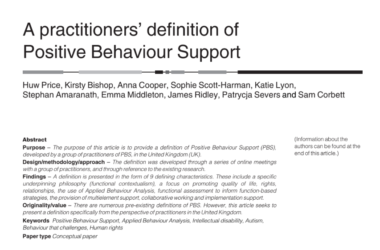
An important new conceptual paper has been released in a PBS Special Issue of The Tizard Learning Disability Review, providing a much-needed “marker in the sand” for the practice of Positive Behaviour Support (PBS) in the UK. Developed by a group of experienced practitioners—including Patrycja Severs, a member of Green Light’s PBS team—this definition clarifies what authentic PBS looks like at a time when the term is often used tokenistically or misunderstood.
See full paper here PBS Practitioner’s Definition
At its core, the paper defines PBS through 9 defining characteristics. These range from a focus on Human Rights and Quality of Life to the rigorous use of Applied Behaviour Analysis (ABA) and Functional Behaviour Assessments to understand the “why” behind someone’s behaviour.
This new definition is particularly meaningful for us at Green Light. As a company dedicated to high-quality support, the paper’s findings resonate with our long-standing commitment to evidence-based, person-centred care.
Evidence-Based Practice over “PBS in Name Only”: The authors express concern that some services simply “say” they do PBS without actually changing their practice. Green Light has always maintained that PBS must be a lived reality, not just a support plan in a filing cabinet.
The Essential Role of ABA: The paper directly addresses the “uncomfortable truth” regarding the role of ABA within PBS, arguing that the approach “lives or dies” with ABA. Practitioners are encouraged not to distance themselves from the science, but to use it ethically to improve lives.
Embedded Practice Leadership: This aligns with our view that high-quality PBS requires embedded practice leadership rather than the occasional visit from an external consultant. Green Light invests in behaviour specialists with Masters-level training and extensive clinical experience who work as a permanent and integral part of our service delivery.
Focus on Capable Environments: The definition emphasises that “behaviour change” refers to changing the environment and caregiver behaviour—not just the person receiving support. This chimes with our focus on creating “capable environments” that reduce distress and promote autonomy.
Commitment to Professional Accountability: One of the paper’s primary “calls to action” is for practitioners to be part of the UK-SBA professional register. We are proud that our behaviour analysts and technicians, including Patrycja in her capacity as a co-author of this paper, align with this high standard of professional accountability.
This paper serves as a reminder that PBS is not a “quick fix” or a “panacea”. It is a long-term commitment to understanding a person’s unique needs, protecting their rights, and helping them achieve a life they value. By establishing our practice in these nine characteristics, we can ensure that the support we provide remains authentic, effective, and deeply respectful.
| Nine Defining Characteristics of Positive Behaviour Support | Description |
| 1. Underpinning Philosophy | PBS follows a functional contextualist philosophy, recognising context’s role in behaviour and valuing the “lived experience” of the person receiving support. |
| 2. Quality of Life Focus | The predominant focus of PBS is upon improving the unique quality of life of the person receiving support. |
| 3. Rights | PBS is delivered in accordance with human rights, with consent and assent addressed in all stages of support, and avoids harsh, punitive, or intentionally aversive strategies. |
| 4. Relationships | Unconditional positive regard is a fundamental aspect, with the development of meaningful relationships dependent on establishing mutuality and reciprocity. |
| 5. Applied Behaviour Analysis | PBS predominantly uses the principles and procedures of ABA to define, assess, and support behaviour change, focusing on the context in which support is delivered. |
| 6. Functional Assessment | Behaviours are recognised as serving important purposes, determined through careful assessment to inform function-based strategies that provide alternative ways for needs to be met. |
| 7. Multielement Support | PBS adopts a multielement approach to change the context of support, including developing understanding, removing sources of distress, and increasing autonomy. |
| 8. Collaborative Working | PBS is not the prerogative of one person or discipline alone and requires collaborative working, including with the person receiving support, family members, and other professionals. |
| 9. Implementation Support | As a long-term approach, PBS requires ongoing implementation support for staff and caregivers, which may include training, coaching, and practice leadership. |
The Tizard Learning Disability Review Special Issue was guest edited by Patrick Behan, Hannah Newcombe, Jo Coulson, Dr Tia Martin, and Chloe-Ann Elmer-May
and includes:
1. Implementing system-wide positive behaviour support through capable environments: a practice-based evaluation Jen Knight; Chloe-Ann Elmer-May Tizard Learning Disability Review (2026) https://lnkd.in/ePKdsdgC
2. The utility of capable environments in a special educational setting: a primary level exploration Anthony Cox; Jen Knight; Amy Nash Tizard Learning Disability Review (2026) https://lnkd.in/eu78etpT
3. Implementing skills-based treatment in naturalistic contexts Huw Price; Hannah Newcombe; Katie Lyon Tizard Learning Disability Review (2026) https://lnkd.in/ePujNXNx
4. The relationship between perceived organisational support and emotional exhaustion in intellectual and developmental disability services Huw Price Tizard Learning Disability Review (2026) https://lnkd.in/e23DScG8
5. A practitioners’ definition of Positive Behaviour Support Huw Price; Kirsty Bishop; Anna Cooper; Sophie Scott-Harman; Katie Lyon; Stephan Amaranath; Emma Middleton; James Ridley; Patrycja Severs; Sam Corbett Tizard Learning Disability Review (2026) https://lnkd.in/eD4aQHXX
6. Human rights re-centred PBS for harmful sexual behaviour at the forensic frontiers Scott Bartle Tizard Learning Disability Review (2026) https://lnkd.in/eZfsSVR9