
At Green Light PBS Ltd., we understand that securing high-quality, person-centred support for an adult loved one who has severe learning disabilities and displays behaviour that challenges is often a deeply complex and exhausting process.
Navigating the legal duties, financial mechanisms, and myriad housing options within the Adult Social Care system in England requires robust knowledge and clear guidance. That is why we recommend a comprehensive resource by The Challenging Behaviour Foundation: Adult Social Care (England) Support options, housing, personalisation and living a good life.
Building Knowledge for Better Decisions
This guide is specifically designed for family carers who are supporting individuals with severe learning disabilities and complex needs. It offers the essential knowledge and tools required to advocate effectively and ensure your relative receives the best possible care.
The resource provides invaluable, easy-to-follow advice, breaking down complex areas such as:
-
Understanding Legal Rights: It details crucial legislation, including the Care Act 2014, which focuses on promoting wellbeing and choice. It also covers the Mental Capacity Act 2005, vital for ensuring decisions made on behalf of an adult lacking capacity are in their ‘Best Interest’ and are the least restrictive possible option. The Equality Act 2010 is also highlighted for protecting rights and ensuring equality of opportunity in accessing services.
-
Assessment and Eligibility: The guide explains how to request a Social Care Assessment for any adult (aged 18 or over) who appears to need support. Crucially, it clarifies the eligibility criteria: your relative must be unable to meet two or more of ten key outcomes, and this must significantly impact their wellbeing, obligating the Local Authority to ensure their necessary support is met.
-
Funding and Personalisation: The resource clarifies the importance of the Personal Budget, which must be sufficient to meet all eligible needs. It outlines options for managing this budget, including using a Direct Payment to give the individual or a family member control over purchasing services. The guide also stresses that Local Authorities must consider Disability Related Expenditure (DRE) during financial assessments, deducting extra costs arising from the disability from any required contribution.
When Things Go Wrong
If you are concerned that the law is not being followed, there may be a need to involve a solicitor to ensure your relative’s and your rights are met. The Government website provides a list of legal aid advisers. Legal aid eligibility depends on the means (finances) and merits (strength) of the case, though some proceedings, such as those challenging detention under the Deprivation of Liberty Safeguards (DoLS), are often non-means tested.
For more detailed information about making a legal challenge, including relevant legislation, please see the Family Carer Advocacy resource pages ‘When things go wrong‘ and the Government’s website for information on Legal Aid Eligibility.
The Green Light Difference: Focusing on Quality Support
As a provider committed to quality support, we recognise the guide’s emphasis on personalised care and effective planning.
We strongly align with the guide’s focus on Positive Behaviour Support (PBS). The guide describes the Positive Behaviour Support Plan (PBS Plan) as a written plan based on functional assessment, which uses proactive and reactive strategies to reduce challenging behaviours and increase quality of life. All staff supporting your relative should follow this plan consistently.
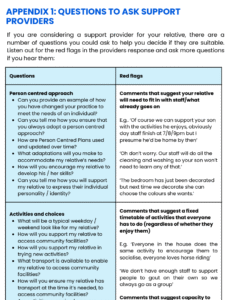
When you are ready to choose a provider, Appendix 1 of this resource provides crucial “Questions to Ask Support Providers.” We encourage you to use these to ensure any service, including ours, demonstrates that it utilises a Positive Behaviour Support approach (the recommended approach for challenging behaviour).
Taking the Next Step
Whether you are navigating the initial assessment stage, choosing between a residential care home or Supported Living, or facing frequent challenges such as lack of appropriate local choice or insufficient funding, this guide provides concrete strategies for challenging issues and advocating for your relative.
Empower yourself with the knowledge found in the Adult Social Care (England) Support options, housing, personalisation and living a good life guide. Being informed is the first step toward achieving the “good life” your relative deserves.
If you encounter barriers in getting services to meet eligible needs, remember the law states these needs must be met, regardless of budget cuts. Knowing your rights, as detailed in this guide, is like having the blueprint for your relative’s quality of life—it ensures you can build a stable foundation even when the system seems designed for confusion.